
We’re excited that bulbs have arrived! We’re unpacking boxes and putting these out for you as soon as as they come in – thanks in advance for your patience.
| GENUS | SPECIES/VARIETY |
| ALLIUM | BUBBLE BLEND – in store now! |
| ALLIUM | aflatunense PURPLE SENSATION |
| ALLIUM | caeruleum (azureum) |
| ALLIUM | amplectens GRACEFUL BEAUTY |
| ALLIUM | MOUNTAIN BELLS MIXTURE |
| ALLIUM | (Nectaroscordum) siculum |
| ALLIUM | rosenbachianum – in store now |
| ANEMONE | blanda BLUE SHADES WINDFLOWER – in store now! |
| BLEND | Allium, Tritelia BUTTERFLY COLLECTOR |
| COLCHICUM | DOUBLE WATERLILY (autumn flowering) |
| CORYDALIS | solida BETH EVANS (pink) |
| CROCUS | sieberi FIREFLY |
| CROCUS | fuscotinctus – in store now! |
| CROCUS | sativa SAFFRON CROCUS (autumn flowering) |
| CROCUS | speciosus AUTUMN CROCUS (autumn flowering) |
| CROCUS | tommasinianus RUBY GIANT – in store now! |
| CROCUS | specie MIXED – in store now! |
| CROCUS | vernus AQUA – in store now! |
| CROCUS | vernus GOLDEN YELLOW |
| CROCUS | vernus MIXED – in store now! |
| CHIONODOXA | forbesii GLORY of the SNOW – in store now! |
| FRITILLARIA | IMPERIALIS RUBRA MAXIMA – in store now! |
| FRITILLARIA | PERSICA |
| GALANTHUS | nivalis SNOWDROPS |
| HYACINTH | DELFT BLUE |
| HYACINTH | PETER STUYVESANT |
| HYACINTH | DELFT BLUE |
| IRIS, DWARF | ALIDA – in store now! |
| IRIS, DWARF | HARMONY – in store now! |
| IRIS, DWARF | PURPLE HILL – in store now! |
| IXIOLIRION | tataricum pallasii MOUNTAIN LILY |
| MUSCARI | azureum AZURE GRAPE HYACINTH |
| NARCISSUS | blend MINIATURE MIX |
| NARCISSUS | blend MOTHER & DAUGHTER |
| NARCISSUS | blend NATURALIZING MIX |
| NARCISSUS | DUTCH MASTER trumpet daffodil – in store now! |
| NARCISSUS | DOUBLE POET’S (Albo Pleno Odorata) |
| NARCISSUS | ALTRUIST small-cup |
| NARCISSUS | BARRET BROWNING small-cup |
| NARCISSUS | JAMESTOWN small-cup |
| NARCISSUS | PHEASANT’s EYE |
| NARCISSUS | DELIBES large-cup |
| NARCISSUS | FERRIS WHEEL large-cup |
| NARCISSUS | JETFIRE miniature |
| NARCISSUS | GOLDEN ECHO miniature |
| NARCISSUS | YAZZ jonquilla |
| NARCISSUS | TETE-A-TETE miniature |
| NARCISSUS | CORNISH KING trumpet |
| NARCISSUS | MOUNT HOOD trumpet |
| NARCISSUS, PAPERWHITE | ZIVA |
| SCILLA | sibirica SIBERIAN SQUILL |
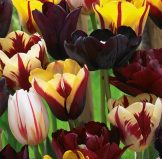
| TULIP | blend BRILLIANT BLUES – in store now! |
| TULIP | blend TRIUMPH MIX |
| TULIP | ANGELIQUE double late |
| TULIP | DANCELINE double late – in store now! |
| TULIP | PEPTALK double late – in store! |
| TULIP | BLUSHING APPLEDOORN Darwin Hybrid – in store now! |
| TULIP | DAYDREAM Darwin Hybrid – in store now! |
| TULIP | LIGHT & DREAMY Darwin Hybrid – in store now! |
| TULIP | RED IMPRESSION Darwin Hybrid – in store now! |
| TULIP | AVIGNON Parrot tulip |
| TULIP | ORANGE EMPEROR fosteriana – in store now! |
| TULIP | FLAMING EMPEROR fosteriana |
| TULIP | BALLERINA lily-flowering – in store now! |
| TULIP | KARATE Triumph – in store now! |
| TULIP | LASTING LOVE Triumph |
| TULIP | PAUL SCHERER Triumph |
| TULIP | SHOCKING Triumph |
| TULIP | BLUEBERRY RIPPLE Rembrandt – in store now! |
| TULIP | HAPPY FEET Rembrandt – in store now! |
| TULIP | viridiflora ARTIST – in store now! |
| TULIP, specie | humilis LITTLE BEAUTY |
| TULIP, specie | humilis PERSIAN PEARL |
| TULIP, specie | greigii RED RIDING HOOD – in store now! |
| TULIP, specie | praestans TUBERGEN’S VARIETY |
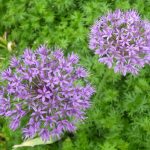
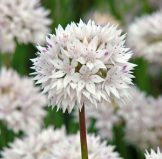 Circa 1857, this delicate-looking yet easy-growing North American native has composite 3″ globes of star-shaped, sparkling white flowers with pale lavender stamens tipped with purple anthers and sturdy stems.
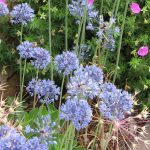 Allium caeruleum (syn. A. azureum) (Blue Globe Onion)
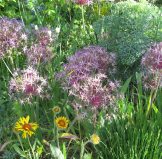 A most surprising, outrageous flower for xeriscapes! The giant globes, to 10” diameter or more, are held on fairly short stems, 8”-18” tall, blooming in mid-spring. The hundreds of starry, silver-lavender florets each have a green ‘eye’ are arranged so that their petal-tips touch to form a perfect sphere. This easy naturalizer has been highly successful in our xeriscape display gardens, eliciting lots of interest. Also spectacular in large flower arrangements, fresh or dried.
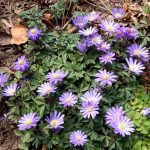 An enchanting, early-blooming member of the Buttercup family that grows from a tuber. Where happy, it spreads to form a carpet-like groundcover with ferny deep green foliage and 1”- wide open-faced sky-blue daisy flowers with yellow eyes. Provides a long-lasting display in early spring.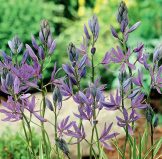
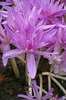 Waterlily Autumn Crocus
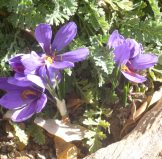 This fall-blooming crocus emerges as a cheery surprise in October or November with bright violet-purple open cupped petals and brilliant orange stigmas, the source of the precious spice, saffron. The blooms are accompanied by short blades of dark green, grass-like foliage which elongates after the flowers have finished and may re-appear in spring.
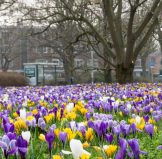 Crocus Specie Mixed
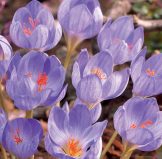 The superb blue Autumn Crocus, blooms in early to mid-autumn, arriving to brighten the garden at a time when many other plants have finished blooming. Autumn Crocus has large, sky-blue to purple flowers with golden-orange stigmas and anthers. They stand 4” tall and emerge without the narrow grassy foliage that will follow bloom. They will naturalize, and over the years, the clumps increase in size and duration of bloom.
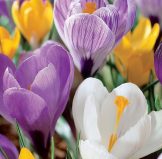 Giant Mixed Crocus Blend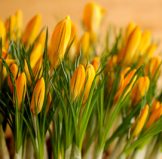

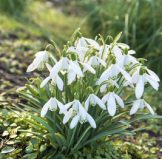 Pendant, bell-shaped white flowers with green-tipped petals are a classic harbinger of spring. They look wonderful planted in groups and may bloom as early as February. Commonly called snowdrop, this bulbous perennial is native to Europe and southwestern Asia.
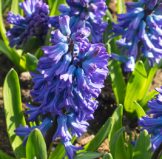 All these highly fragrant Dutch Hyacinth varieties are perfect for spring gardens and for forcing indoors in pots or hyacinth glasses. They are long-lived in the garden if fertilized after blooming, and after the first year they will produce more flower spikes that are less densely packed and more natural-looking. Hyacinths are quite easy to grow in a sunny or partly shaded spot.
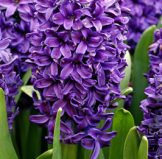 All these highly fragrant Dutch Hyacinth varieties are perfect for spring gardens and for forcing indoors in pots or hyacinth glasses. They are long-lived in the garden if fertilized after blooming, and after the first year they will produce more flower spikes that are less densely packed and more natural-looking. Hyacinths are quite easy to grow in a sunny or partly shaded spot.
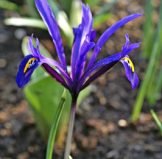 An irresistible little iris that grows no more than 5-6″ tall. Its dazzling, royal blue petals have showy white and yellow markings and the flowers are sweetly fragrant! Perfect for rock gardens or along a walkway where the soil is well-drained and relatively dry. Blooms in late winter along with the crocuses.
 Native to rocky hillsides from SW and Central Asia (Syria to Afghanistan), this lovely wildflower in the Amaryllis family bears umbels of starry violet-blue flowers with darker midveins above grass-like foliage for 3 to 4 weeks in late May and early June.
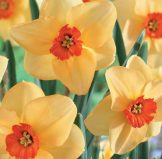 While ‘Altruist’ Narcissus has the classic daffodil look, the colors are anything but ordinary! This striking award-winner has a 3″ coppery golden-orange perianth that pales as it matures, the perfect background for the shallow, bowl-shaped crimson-orange cup. Altruist is long-lived and floriferous, and its unusual and gorgeous coloring make it a stand-out in the garden and as a cut flower. Pest-proof!
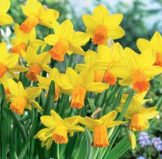 An old favorite for naturalizing, and another Cyclamineus daffodil. Bright and cheerful in the garden, with reflexed vivid yellow petals and orange-red trumpet. ‘Jetfire’ is early blooming, and increases rapidly to form showy colonies. Very long-blooming, tough and adaptable. Also good for forcing indoors.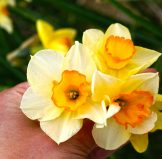
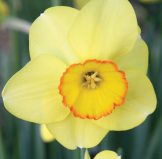 Pacific Rim Daffodil
 One of the best heirloom award-winning Cyclamineus daffodils, we have grown this miniature variety in our Xeriscape Rock Garden for many years. The graceful, floriferous early-bloomer has a reflexed, buttercup-yellow perianth surrounding a trumpet-like, darker yellow cup. For naturalizing, rock gardens, border plantings, and forcing. Hardy to Zone 4, 6” – 7” tall, Deer and rodent-proof! Plant 6” deep, 3-6″ apart.
 Potted Paperwhites bring delightful fragrance to your home in winter, and make wonderful holiday gifts. They bear trusses of heavenly-scented, pure white flowers on up to three stems per bulb. They may be planted in all kinds of decorative pots, vases and trays, either in soil or pebbles, from now through February.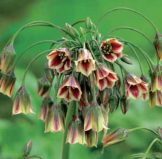

 A gorgeous, sturdy, low-growing (8”) naturalizing tulip, perfect for the rock garden, meadow or perennial border. ‘The First’ is very early, blooming in March or April. When closed, the red and white outer petals present a candy-cane striped effect. On sunny days, they open wide (~4″) and look like single waterlilies, revealing an ivory white interior with a bright yellow center and, sometimes, small coral-red markings.
 NEW for 2019!
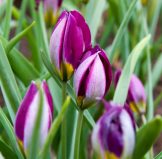
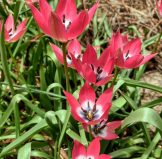 These adorable Species Tulips have reddish-pink petals with glowing, blue-eyed centers.
 The full petals of this bright and stylish Amaryllis are a saturated red, overlaid with a white star and accented by stippled veining and a light green throat.
 A gorgeous, bright red flower with wide petals. A perfect holiday decoration!